

family scheduling
Shared Calendars Help, But They Do Not Solve Family Scheduling on Their Own
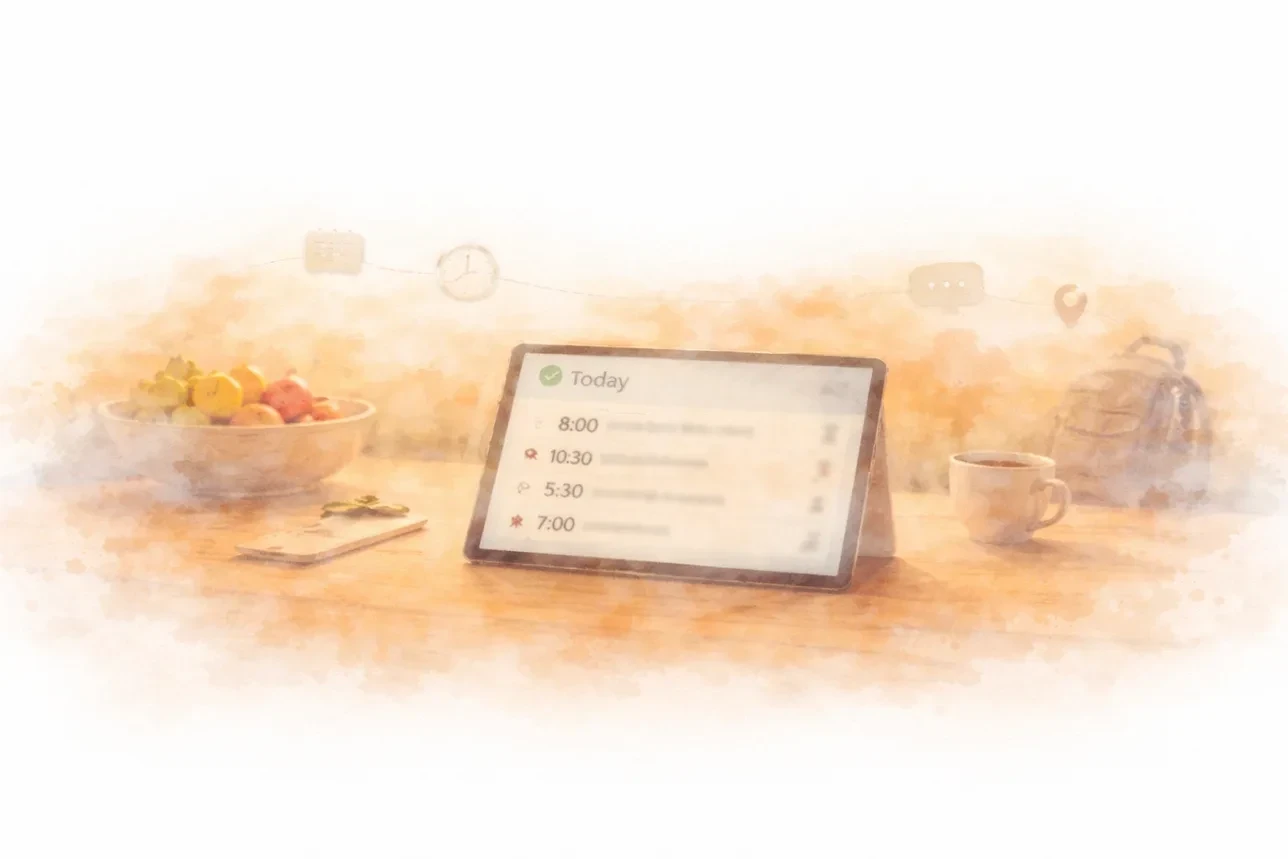
Shared calendars are genuinely useful. They let multiple people access the same information, reduce some back-and-forth, and create a single place where appointments, activities, and reminders can live.
That matters.
But shared access does not automatically create good family scheduling.
In many households, a calendar can be technically shared while still failing to improve day-to-day coordination in meaningful ways. The information exists. Everyone may even have permission to view it. Yet the same questions, missed handoffs, and last-minute surprises still happen.
That is because family scheduling is not only about whether information is available. It is also about whether the right people actually see it, at the right moments, in the flow of normal life.
Shared calendars solve access, not every coordination problem
A shared calendar helps put the same schedule in one place. That is an important step forward compared with scattered texts, paper notes, and information that only one person carries mentally.
But family coordination often breaks down after that step.
A schedule may still live mostly inside personal phones. It may be hidden behind app habits, logins, notification settings, or simply the fact that someone has to remember to open it. In practice, that means one person often still becomes the human reminder system for the household.
The calendar is shared. The mental load is not.
This is especially noticeable in busy families where the day includes school events, pickups, recurring appointments, extracurriculars, work obligations, and shifting responsibilities between caregivers. Even when everyone technically has access, daily coordination can still depend on one person repeating what is already in the calendar.
Why family scheduling still breaks down
The problem is not usually that calendars are missing. The problem is that visibility is still inconsistent.
A shared calendar can fail to improve family scheduling when:
- it is only checked reactively instead of seen naturally
- children or other household members do not have practical access
- one adult carries most of the responsibility for checking and relaying information
- schedule changes are easy to miss unless someone actively goes looking for them
- important details are present, but not visible at the moments when decisions are being made
This creates a subtle but important gap between shared information and shared awareness.
That gap is where friction lives.
A family can have a good calendar system on paper and still struggle with ordinary moments like getting out the door in the morning, knowing what is happening after school, remembering who is handling pickup, or noticing that an appointment changed.
A family schedule works better when it is easier to see
For many families, the most helpful improvement is not another app, another alert, or another layer of complexity.
It is better visibility.
When the household schedule is visible in a central place, it becomes easier to reference without effort. Instead of relying on each person to actively check a device, the day becomes something that can be seen while people move through normal routines.
That matters because family life is usually coordinated in motion.
It happens in the kitchen before school. It happens while making coffee, packing lunches, leaving for work, handling transitions, or figuring out what the afternoon looks like. Those are the moments when people need scheduling clarity most, and those are also the moments when opening an app is least likely to happen consistently.
Why a central kitchen display can help
A shared display in a central household location changes how a calendar functions.
Instead of being a private tool accessed individually, it becomes a shared reference point for the home.
The kitchen is often the most natural place for that. It is where routines overlap. It is where people pass through repeatedly. It is where scheduling questions tend to surface in real time.
A central display does not replace the underlying calendar system. It simply makes that information easier to see where daily life is already happening.
That can help reduce several common family scheduling problems:
- fewer repeated questions about what is happening today
- less dependence on one person to relay calendar information
- better awareness of appointments, activities, and transitions
- easier at-a-glance understanding of the day for the whole household
- a clearer shared sense of what is coming next
In other words, the schedule becomes more visible without demanding more effort.
A simpler display can be more useful than a full interface
This is one reason simplified display modes can matter more than they first appear.
A full app interface is useful when someone needs to manage details, edit events, or work inside the system directly. But that is not the same as designing for shared household visibility.
For a shared family display, the goal is different.
The information needs to be easier to scan from a distance. The text needs to be larger. Extra interface elements need to get out of the way. The screen should feel less like an app and more like a clear household surface that supports family scheduling at a glance.
That is part of the thinking behind the kiosk-style approach in Coming Up Today. Instead of treating the display like a standard personal app view, it can be simplified so the schedule is easier to see in a shared space, with less visual clutter and more emphasis on clarity.
Better family coordination is not just about sharing
Shared calendars still matter. They are useful, necessary, and often much better than having no shared system at all.
But they do not solve family scheduling on their own.
Access is only one layer of coordination. Families also need practical visibility. They need the schedule to be easy to notice, easy to reference, and easy to understand in the places where daily decisions are actually being made.
That is why a central shared display can make such a meaningful difference. It does not change the fact that the calendar is shared. It changes how visible that shared information becomes in ordinary life.
And in many households, that is the layer that has been missing all along.
If you are thinking through ways to reduce scheduling friction at home, start by asking a simple question: is the calendar merely shared, or is it actually visible enough to support everyday coordination?
For more writing on family coordination, shared scheduling, and designing tools that reduce household friction, browse the ComingUp Today Dev Diary.