

Family Coordination
Why Individual Calendars Don’t Scale for Family Coordination
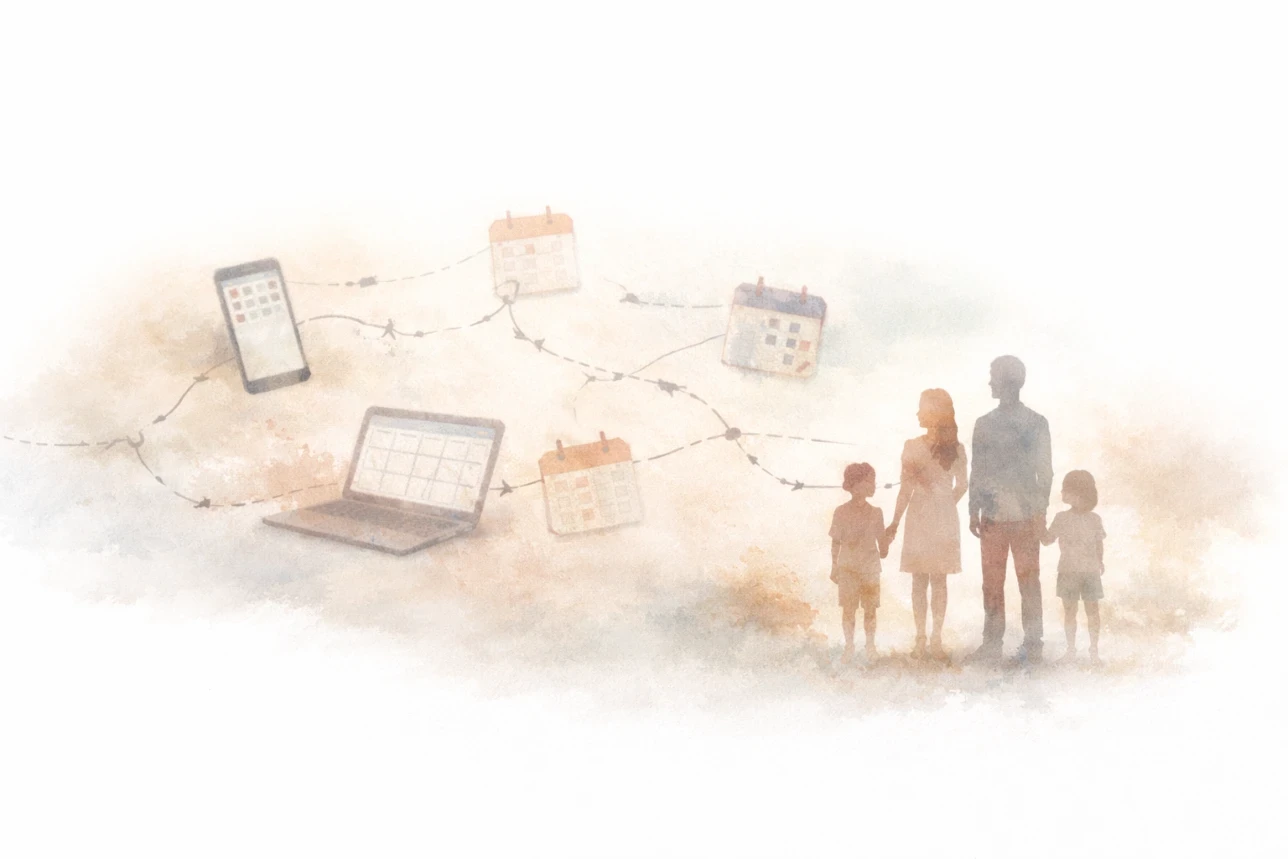
Personal calendars are essential for individual time management. Most adults rely on them to keep track of meetings, appointments, reminders, and tasks. What works well for a single person often breaks down when calendars are expected to serve a group — especially a family with multiple schedules, responsibilities, and priorities.
When calendars are used across households, a fundamental limitation shows up: personal calendars were built around ownership, not shared understanding. That distinction might seem subtle, but in day-to-day life it drives invisible coordination friction that leads to confusion, missed events, and extra communication overhead.
Calendar Fragmentation in Family Schedules
In a typical family, no one calendar governs everyone’s life. A parent may rely on a work calendar tied to an employer’s system, another parent might use a separate personal calendar in a different ecosystem, and kids’ school or activity schedules can be delivered through yet another app or feed. This fragmentation means each person’s schedule exists in a silo.
External calendars from schools, sports leagues, or community groups rarely sync cleanly into a household calendar unless someone manually combines them. By the time a family member does that work — toggling between accounts, merging feeds, or forwarding invites — much of the coordination value has already been lost. This kind of fragmentation creates gaps in shared awareness, not because people don’t care but because the calendars themselves don’t provide a unified context for multiple people to see what matters.
This is similar to why shared calendars often fail in practice — a topic we explored deeply in our article on why shared calendars break down for families and small groups. Shared tools still rely on integrating individual ownership constructs rather than building shared understanding first.
The Permission Problem: Ownership vs Visibility
Calendar platforms treat events as property of an account. When you share your calendar with someone else, you are extending control or visibility based on permission levels. Giving someone edit access risks unwanted changes or confusion over who owns what. Giving someone view-only access often hides important context — details within event descriptions, attached notes, or subtleties that matter to coordination.
Coordination requires visibility without control. In practice, personal calendars are optimized for control — what the individual owns and manages. This mismatch is one reason families struggle when they lean solely on personal calendar tools to coordinate events across multiple people.
Privacy Tradeoffs and Missing Calendar Details
Another layer of friction arises from privacy concerns. Many people are understandably hesitant to record sensitive life details — medical appointments, private meetings, or personal commitments — in a cloud calendar associated with large providers. The result is often abbreviated titles, omitted notes, or even events kept outside of any shared calendar.
This creates another type of coordination gap: incomplete context. When events lack sufficient detail or are only partially recorded, others are left guessing. Those gaps may be hidden — a cryptic calendar title, a missing note, or an event that simply “looks like nothing” to someone else in the household. Missing context isn’t a flaw in people’s intentions; it’s a side effect of tools that were not designed to handle multi-person understanding.
Beyond Dates and Times: Relational Meaning Matters
Calendars record dates, times, and locations. But they do not intrinsically express relationships — who is responsible for what, which person an event affects, or how events connect across schedules. In complex family environments like co-parenting or multi-caregiver households, these relational signals matter deeply.
For example, knowing that a 3:45 PM event is your child’s soccer practice is one thing. Knowing who is responsible for getting them there, who has transportation first, and how that event interacts with another caregiver’s schedule is another. Personal calendars do not natively encode those relational cues, which is why families often resort to supplemental communication — texts, messages, or repeated verbal reminders — defeating the purpose of a single source of truth.
This relational need is highlighted in use cases like co-parenting calendar coordination, where editable shared calendars often make matters worse by creating permission conflicts and arguments over control rather than improving clarity.
Why “Just Share Your Calendar” Isn’t Enough
A common suggestion for families struggling to coordinate is to “just share your calendar.” While sharing can help in limited cases, it rarely solves the core problem of fragmented accounts and incomplete context. Simply merging calendars does not address the fact that individual calendars may live on different platforms, have different levels of privacy, and treat event ownership differently.
What families — and many small groups — actually need is neutral visibility across everyone’s calendars without forcing everyone to edit the same source or relinquish control. This is a fundamental design shift. Instead of collapsing every schedule into one giant shared calendar where permissions become contentious, better coordination starts with a layer that respects individual control while providing consistent visibility.
A Path to Better Coordination
A practical way to reduce coordination friction is to adopt solutions that aggregate visibility from multiple calendars into a shared view, while preserving individual ownership and privacy. For example, integrating systems that bring together events from Google Calendar, Apple Calendar, or other providers into one unified view makes it easier for families to see what’s coming up without overwriting anyone’s personal schedules. This approach aligns with the coordination philosophy behind use cases like Complex Households, where everyone keeps their own calendar but can see what matters in one place. Families often only need read-only aggregated visibility — a view that brings everyone’s calendars together without forcing shared editing, permissions, or overwriting personal control.
When families say, “I didn’t know that was today,” the problem is usually not effort. It’s a visibility gap created by fragmented systems, inconsistent sharing, and missing relational context. Personal calendars remain indispensable for individual organization, but to scale for family coordination they need to be combined with systems built for shared visibility, context, and awareness.
That is a different design challenge than simply building a better personal calendar. It’s a coordination problem — and solving it requires tools and structures that bring people together without sacrificing personal control.