

family coordination
Why Shared Calendars Break Down for Families (And Small Groups)
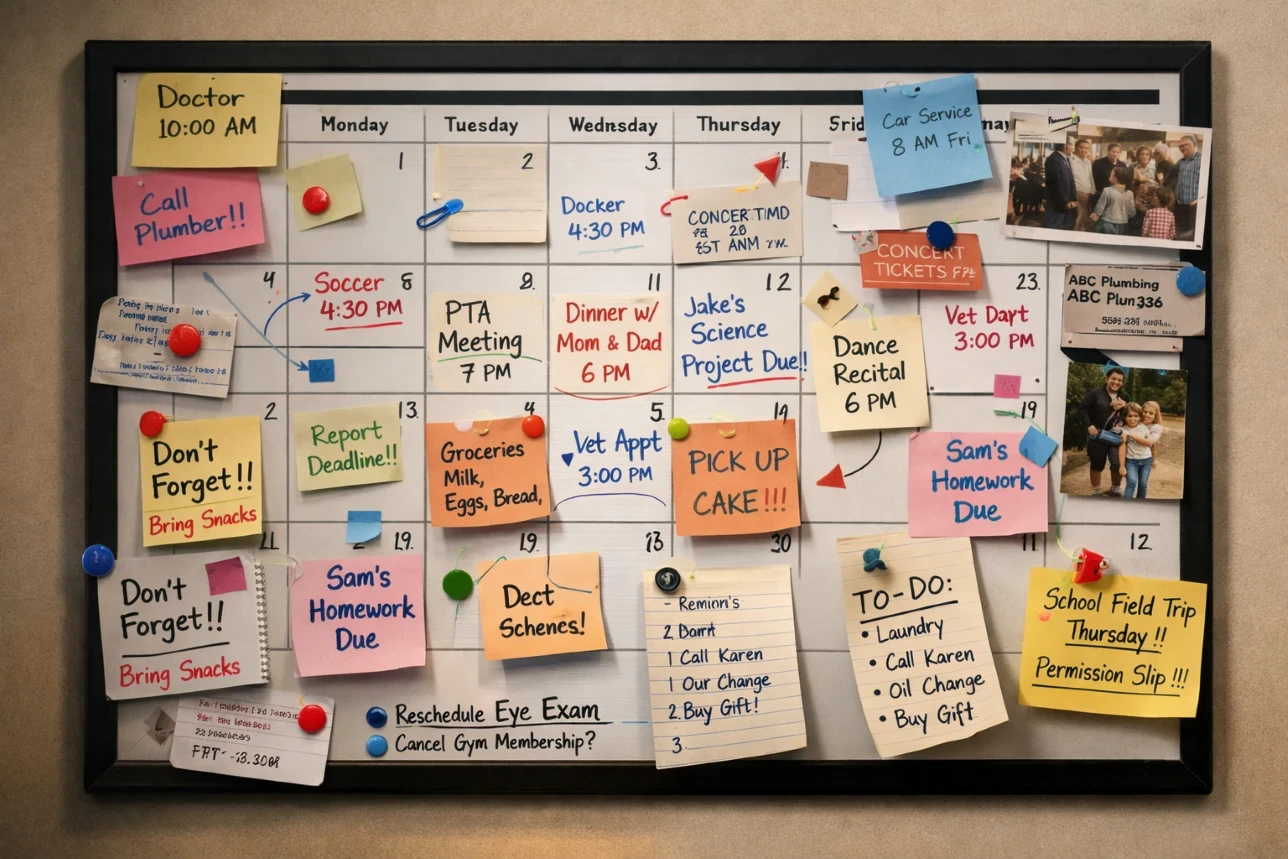
Shared calendars are usually the first solution people reach for when schedules get busy. On the surface, the idea is simple: put everything in one place, share it, and coordination should become easier.
In practice, the opposite often happens.
Even without kids, combining work and personal calendars can quickly become overwhelming. Meetings, deadlines, reminders, and personal commitments stack on top of each other until the calendar becomes more noise than signal. Add more people — a family, a small business, or a volunteer group — and the problem compounds fast.
This is another example of the same pattern I’ve written about before: coordination rarely fails because people don’t care, but because context gets lost as systems grow more complex. That communication friction tends to surface quietly, and only after something important is missed. I explored that idea more broadly in Every Problem Is a Communication Problem.
When everything is important, nothing is clear
One of the first problems people run into is sheer density. When personal and work calendars are jammed together, it becomes difficult to tell at a glance what actually matters right now.
In an attempt to focus, people start hiding calendars. Work gets hidden during personal time. Personal events get hidden during the workday. This works — until it doesn’t.
It’s easy to forget to turn a calendar back on. A meeting gets missed. An event never shows up. And when that happens, there’s rarely a good explanation beyond a small, silent mistake that snowballed.
For families and small teams, those mistakes carry more weight. They don’t just affect one person — they affect everyone who depends on shared awareness.
Families don’t just need dates and times
In a household with multiple children, dates and times alone aren’t enough.
Most days, the real questions are:
- Who is this event for?
- Who needs to be there?
- Where exactly is it?
- Who is responsible for getting them there?
With three children at different ages, events can look deceptively similar. Sometimes two kids attend the same activity. Sometimes they don’t. Sometimes the location changes. Sometimes it doesn’t.
Traditional calendar tools don’t make this easy to express. Outside of notes or meeting invites, there’s no clean way to attach structured context to an event. This is why events often end up overloaded with text, screenshots, or follow-up messages instead of being clearly defined in one place. The problem isn’t the event itself — it’s how events are modeled and shared, which is why having a clear way to represent how events actually work matters more than most people realize.
External calendars quietly fragment information
Many activities introduce their own calendars — homeschool groups, clubs, organizations, or other outside groups. These calendars are often shared with one parent, one email address, or one account.
Now information lives in exactly one place, and everyone else is expected to know where to look.
One parent sees it. The other doesn’t. Someone assumes it was shared. It wasn’t. And suddenly coordination depends on memory, screenshots, or forwarding links around.
Even when tools like Google Calendar are involved, the friction doesn’t go away — it just shifts. External calendars are easy to subscribe to, but harder to reason about once multiple people, devices, and visibility needs are involved. That’s where understanding how shared data flows — and how read-only access works — becomes important, especially when dealing with calendar integrations like Google Calendar.
Context gets scattered across tools
Over time, important details end up split across:
- Calendar events
- Text messages
- Notes apps
- Verbal conversations
- Someone’s memory
Addresses live in one place. Phone numbers in another. Names, locations, and responsibilities get repeated inconsistently — if they’re written down at all.
This is especially painful when the same locations or organizations come up repeatedly. Dance studios, homeschool groups, activity centers — all of them have contact information that rarely changes, yet often gets retyped or resent. When contact details aren’t treated as first-class information, they drift. That’s why separating and clearly modeling contacts and related information becomes just as important as the calendar itself.
At that point, the calendar stops being a source of truth and becomes just one piece of a much larger, messier system. It’s a small miracle more things don’t get missed.
This isn’t just a family problem
The same breakdown shows up in small businesses and groups.
A restaurant trying to share server schedules. A small team coordinating shifts. A group where visibility matters more than editing. Once multiple people are involved, shared calendars start to feel heavy.
- Who should see what?
- Who should be allowed to edit?
- Which calendar should this go on?
- Did everyone get the update?
The overhead of managing the process begins to outweigh the value of the calendar itself.
The difference between control and awareness
Most people don’t actually want more control. They want awareness.
They want to quickly answer:
- What’s happening today?
- Roughly when?
- Who is this for?
- Where is it?
They want that visibility without worrying that something was accidentally changed, hidden, or overwritten. They want context without micromanagement.
Shared calendars, as they’re commonly used, are optimized for editing — not for shared understanding.
Why this keeps happening
The failure isn’t technical. It’s conceptual.
Calendars are treated as containers that everyone must share, instead of personal sources of information that can be viewed together. As soon as editing becomes the default, complexity and risk follow.
More people means more chances for mistakes. More calendars means more fragmentation. More tools means more context switching.
Eventually, people stop trusting the system — and start asking questions again.
What actually helps
What works better is not forcing everything into one editable calendar, but allowing people to keep their own calendars while making the important parts visible in one place.
- Read-only visibility.
- Clear context.
- Per-person awareness.
- Minimal overhead.
If you want to see how that approach is structured at a high level — without diving into implementation details — there’s a simple overview of how it works.
That design philosophy is what shared calendars consistently miss, and why they tend to break down as soon as real life gets involved.
This read-only coordination write-up connects directly to this solution setup, which is built for visibility without handing over edit access.