

family coordination
Why Real-Time Visibility Changes Family Coordination
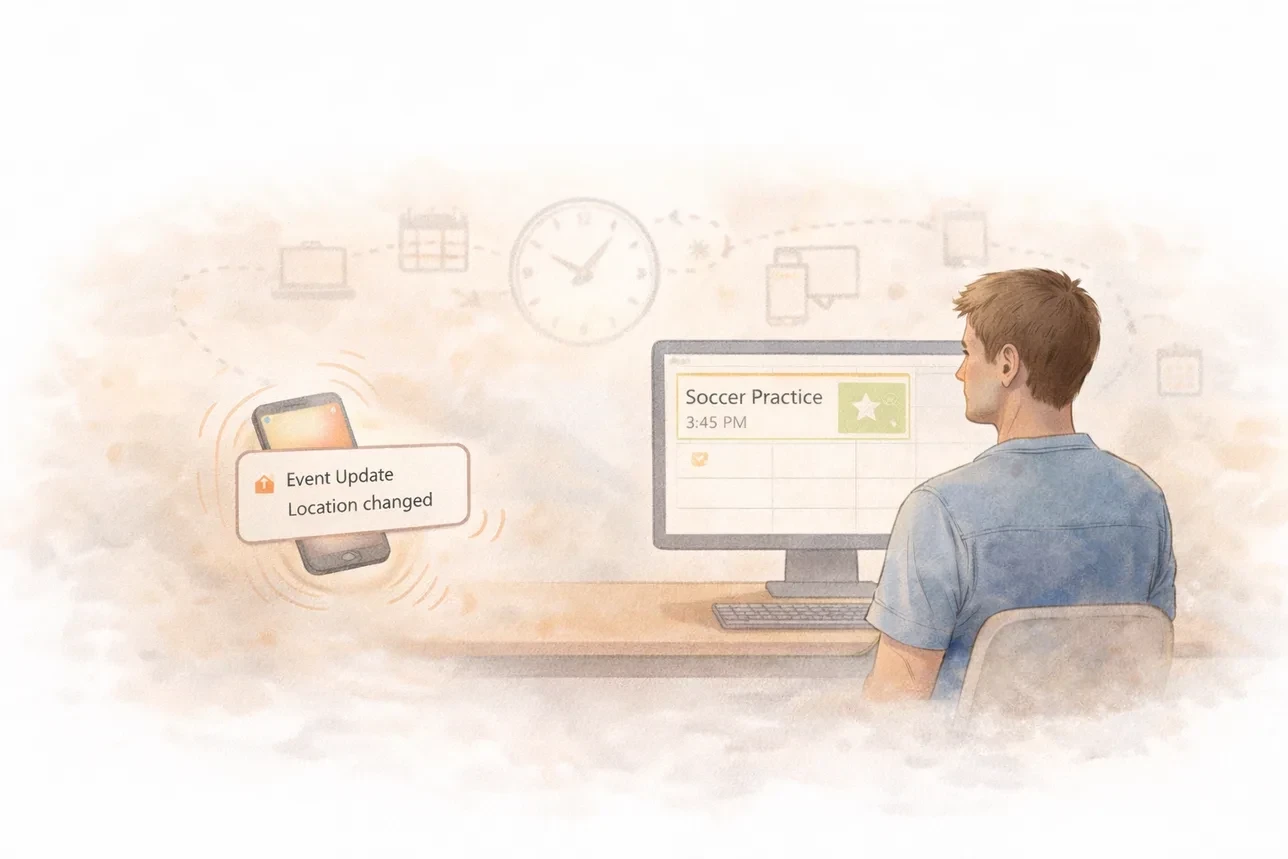
Information by itself rarely solves coordination problems.
Most families already have calendars filled with events, reminders, and appointments. Dates and times are written down. Notifications are often enabled. And yet confusion still happens.
Someone misses a detail. Someone assumes a plan hasn’t changed. Someone shows up at the wrong time or the wrong place.
The problem is rarely that information doesn’t exist.
The problem is that information is not always visible at the moment it matters.
Coordination Happens in Motion
Schedules are not static. They evolve throughout the day.
An appointment gets moved thirty minutes later.
A practice location changes.
A reminder gets added to an event.
A parent updates who is responsible for transportation.
In many scheduling tools, those changes eventually appear everywhere — but not immediately. Devices refresh at different times. Some apps require manual refresh. Notifications may only appear on one device.
For a single person managing their own calendar, these delays usually aren’t catastrophic.
But for families and small groups coordinating around shared responsibilities, even small delays in visibility create friction.
The result is familiar:
“I didn’t see that change.”
“I thought that was still at the old time.”
“I didn’t know the location moved.”
These aren’t failures of effort. They’re failures of synchronization and visibility.
Why Static Calendars Break Down
Traditional calendars behave more like documents than living systems.
You open the calendar, read the information, and assume it represents reality. But if something changed elsewhere — on another device or in another app — that assumption may no longer be true.
This becomes even more complicated in households where schedules come from multiple sources:
- personal calendars
- work calendars
- school calendars
- activity schedules
- internal family events
As discussed in our article on why individual calendars don’t scale for family coordination, these fragmented sources already make it difficult to maintain shared awareness.
When updates are not visible quickly, the coordination gap grows wider.
The calendar may technically contain the correct information — but not everyone sees it at the same time.
Visibility Across Devices Matters
Real life coordination doesn’t happen on a single device.
A parent may glance at the schedule on a phone in the morning, check it again from a laptop at work, and review the day’s plan later on a tablet in the kitchen.
If a scheduling system is tied too closely to a specific device or app instance, the information people see can drift out of alignment.
This is one reason the concept of a shared “coming up” view is so powerful. Instead of requiring everyone to manage the same calendar or constantly switch accounts, families benefit from a shared visibility layer that shows what matters across people and calendars.
You can see this idea reflected in how ComingUp Today works: external calendars remain under individual control, but events appear together in a unified view designed for coordination rather than ownership.
The goal is not to replace personal calendars, but to ensure that everyone who needs awareness can see the same schedule context.
Real-Time Visibility Reduces Coordination Friction
When schedule updates become visible immediately across devices and sessions, the coordination dynamic changes.
Instead of relying on periodic refreshes or delayed synchronization, the system reflects changes as they happen. A modified event quickly becomes visible anywhere someone is viewing the shared schedule.
This does not mean constant notifications or distracting alerts.
In practice, it simply means that the schedule people are looking at remains accurate and current.
The difference may sound subtle, but its impact on coordination is significant. Small misunderstandings disappear before they have time to compound into larger problems.
Instead of discovering changes hours later, everyone sees the updated information while planning the day.
Real Life Requires Shared Awareness
Family coordination often involves more than two people.
Parents, children, caregivers, extended family members, and sometimes outside professionals all interact with the same schedule. Each person may only be responsible for part of it, but they still need visibility into the broader context.
This is especially true in environments like:
In these situations, clarity is not created by giving everyone control over the same calendar.
Clarity comes from shared awareness of what is happening and when.
Real-time visibility strengthens that awareness by ensuring the schedule people see is always as close to reality as possible.
From Static Calendars to Living Schedules
Calendars began as static tools: ways to record events so individuals could manage their time.
But modern family coordination is not an individual activity. It is a distributed system of responsibilities, people, and changing plans.
To work well in that environment, schedules must behave less like documents and more like living systems — capable of reflecting changes as they happen.
When that visibility exists, something subtle but important occurs.
The number of clarifying messages drops.
Arguments about “who knew what” become less frequent.
And families spend less time trying to reconcile conflicting versions of the schedule.
Real-time visibility doesn’t eliminate complexity.
But it ensures that everyone navigating that complexity can see the same reality at the same time.