

family coordination
Why Most Scheduling Apps Send Too Many Notifications
Notifications are supposed to solve a simple problem.
If something important happens, the system lets you know.
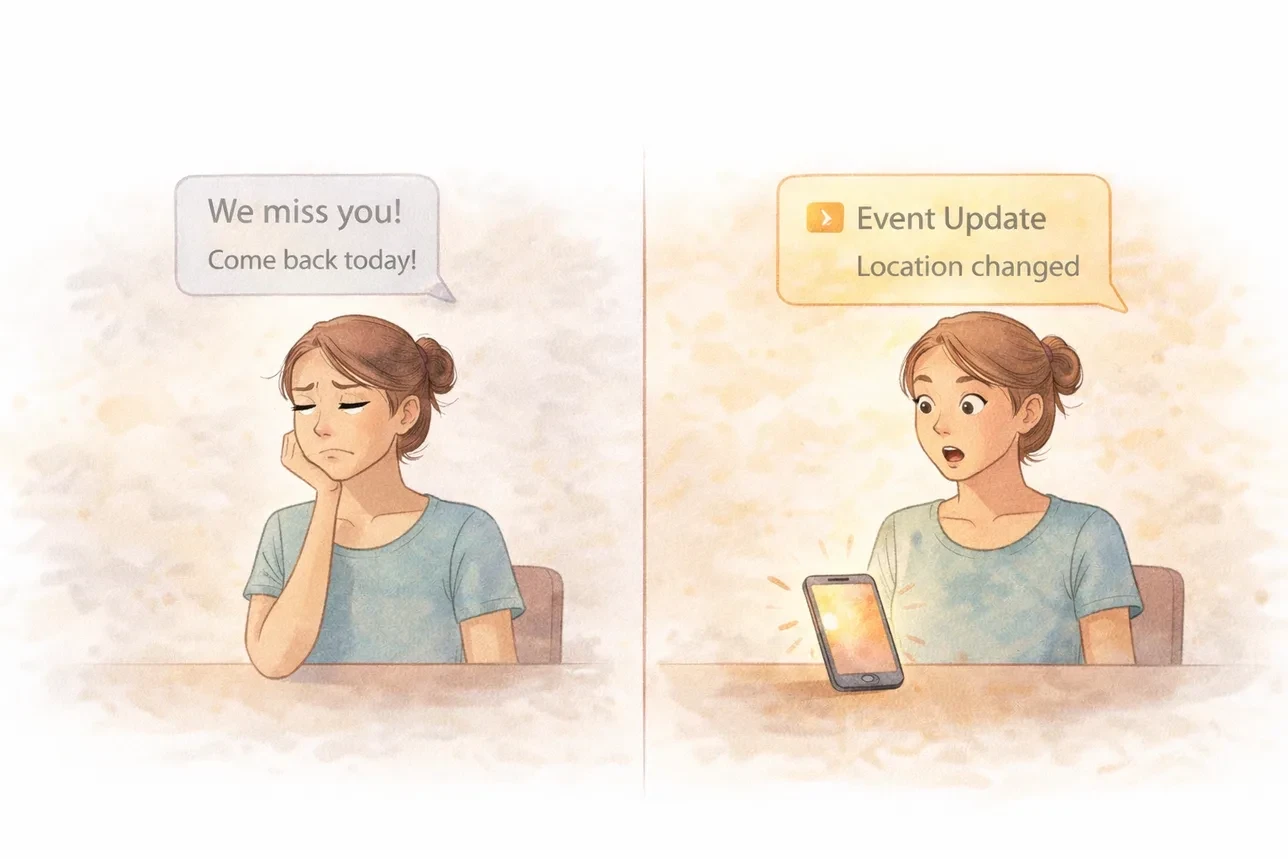
In theory, this sounds straightforward. But in practice, most apps send far more notifications than people can realistically pay attention to. Calendar reminders, marketing alerts, engagement prompts, “we miss you” messages, and activity updates all compete for the same small space on a phone’s lock screen.
The result is predictable.
People start ignoring them.
Researchers often refer to this as alert fatigue — the point where too many notifications cause people to disable them or simply stop paying attention altogether.
Ironically, the more notifications a system sends, the more likely users are to miss the ones that actually matter.
The Difference Between Engagement and Awareness
Many apps treat notifications as an engagement tool.
They exist to pull people back into the application, increase activity, and keep users interacting with the platform. Push notifications can be effective for this purpose, and many systems rely on them heavily to encourage interaction.
But scheduling systems serve a different purpose.
They are not entertainment platforms or social networks. Their job is not to keep users constantly opening the app. Their job is to make sure people know what is happening when it matters.
This distinction changes how notifications should be designed.
Instead of maximizing the number of notifications sent, coordination tools benefit from maximizing the relevance of the notifications that exist.
When Reminders Stop Being Helpful
Most calendar tools send reminders at a fixed interval before an event.
Thirty minutes before.
Ten minutes before.
Maybe the night before.
These reminders are useful — up to a point.
But reminders assume that nothing changes after they are delivered. In real life, that assumption often breaks down.
Imagine receiving a reminder that your child’s soccer practice starts at 3:30 PM.
You grab your keys and start driving.
But ten minutes later, the practice location changes.
The reminder you received was technically correct when it was sent. But by the time you act on it, the information is already outdated.
This is where traditional reminder systems fail. They treat notifications as static signals tied to a schedule rather than dynamic signals tied to changing information.
The Idea of “Danger-Close” Updates
One way to solve this problem is to send notifications only when they are truly necessary — and especially when something changes close to the moment an event is happening.
This idea can be thought of as a danger-close notification.
If a reminder has already been delivered and the event is about to occur, a second notification may be warranted — but only if something critical changes.
For example:
- the event time changes
- the event location changes
- the event is cancelled
These changes affect what someone should do right now.
Other updates — like a description edit or a new note added to the event — rarely justify another alert. Sending notifications for every minor update only adds noise.
By limiting alerts to the changes that truly affect immediate behavior, notifications regain their usefulness.
Why Restraint Improves Awareness
When notifications are rare and meaningful, people pay attention to them.
When they arrive constantly, they become background noise.
Studies of notification systems across many domains have shown that reducing unnecessary alerts improves performance and reduces cognitive strain.
In scheduling and coordination systems, this principle becomes even more important.
Families coordinating school events, appointments, practices, and activities already manage complex schedules. The goal of notifications is not to add more information to that system, but to highlight the moments when information has changed in a way that matters immediately.
Real-Time Systems Make Smarter Notifications Possible
For notifications to remain meaningful, the system behind them must understand when important changes occur.
This is one reason real-time systems are increasingly important in coordination tools.
As discussed in our article on why real-time visibility changes family coordination, schedules are constantly evolving. When an event changes, that update needs to become visible quickly across devices and people.
Modern web technologies such as Progressive Web Apps (PWAs) allow applications to deliver push notifications and updates across phones, tablets, and computers from a single web-based platform.
This capability allows scheduling systems to notify people only when necessary while still ensuring that important updates reach them wherever they are.
Fewer Notifications, Better Coordination
Good notification design is not about sending more alerts.
It is about sending the right alert at the right moment.
In a coordination system, that moment often occurs when something changes shortly before an event begins — when someone may already be on their way.
When notifications are designed with restraint, they stop competing for attention and start doing what they were originally meant to do:
ensuring that people know when something important has changed.
And in family coordination, sometimes that single notification is the difference between arriving at the right place — or driving across town to the wrong one.