

Family Coordination
Control vs Visibility: Why Most Tools Optimize the Wrong Thing
Coordination friction is often treated as a feature problem.
If confusion happens, the assumption is that the tool needs better permissions. More granular settings. Clearer ownership rules. More shared access.
But what if the friction isn’t caused by a lack of control?
What if it’s caused by a lack of visibility?
Most scheduling systems were built around a core assumption: events belong to someone. They are owned, edited, and managed by an account. Sharing is layered on top of that ownership model.
That design philosophy makes sense in enterprise software.
It makes far less sense in families.
Tools Optimize for Control
In most systems, the primary questions are structural:
- Who owns this event?
- Who can edit it?
- Who can delete it?
- What permission level applies?
This model evolved in environments where governance matters. In professional software, ownership determines accountability. Access control prevents errors. Audit trails protect institutions.
Control organizes authority.
But family coordination is not governance. It is awareness.
In a household, multiple people may need to understand an event without needing the power to modify it. A parent schedules a practice. Another caregiver handles transportation. A third person may simply need to know timing to avoid conflicts.
They do not need authority.
They need clarity.
When systems treat visibility as a byproduct of control — something granted through permissions — coordination becomes dependent on sharing mechanics rather than shared understanding.
A Real-World Example of the Mismatch
Consider a common scenario with shared calendars.
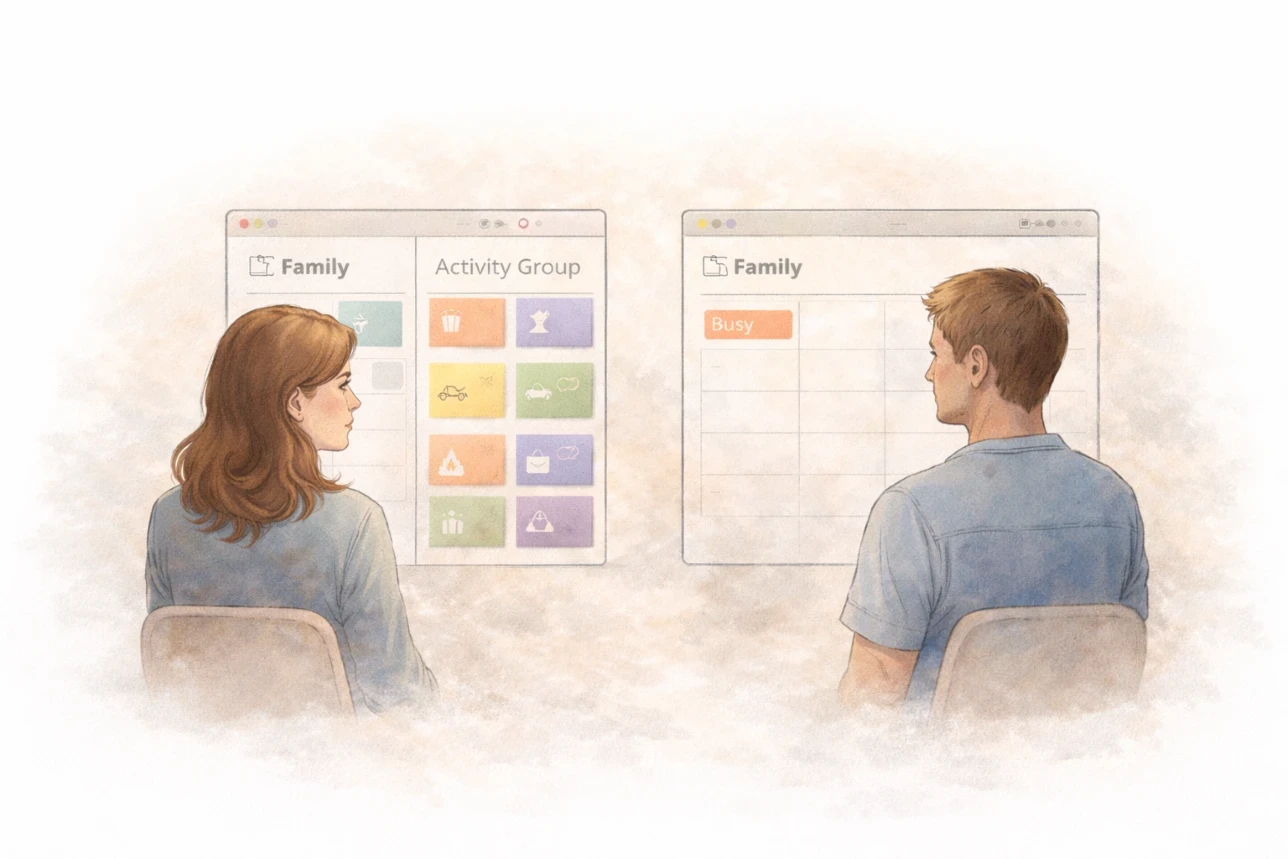
A youth activity organization provides a shared calendar. It is shared directly with Mom’s Google account. Mom also maintains a separate family calendar that she shares with Dad.
From Mom’s perspective, everything feels connected. The activity calendar is visible on her device. The family calendar is shared with Dad. It is easy to assume that the visibility flows through.
But it doesn’t.
Dad cannot see the activity organization’s calendar because it was never shared directly with him. He only sees the family calendar — not the externally shared one.
Now imagine Dad is responsible for taking the kids to that activity one evening. He checks the family calendar. Nothing is there. He assumes there is no event. Mom assumes he sees it because she sees it. The misunderstanding isn’t about effort. It’s about structure.
Editing rights would not fix this.
Granting Dad the ability to edit the activity calendar is irrelevant. The issue is that he cannot see it at all. The system optimized for access control, not shared visibility.
This is the kind of structural gap we’ve previously described in why shared calendars break down for families and small groups.
The problem is not permissions.
It is visibility.
Governance vs Awareness
Enterprise software evolved in environments where governance is critical. Legal compliance, audit trails, and strict ownership hierarchies shape how systems are built. Access is deliberate. Control is explicit.
Families operate differently.
Work systems, school portals, extracurricular organizations, medical providers, and legal agreements each generate their own schedules. There is no single authority that governs all of it. There are multiple sources of truth.
Trying to centralize control into one account often increases friction. Someone becomes the default scheduler. Someone becomes the gatekeeper. That dynamic introduces tension rather than clarity.
Families are not trying to manage authority.
They are trying to reduce uncertainty.
Visibility as Infrastructure
True coordination requires a shift in philosophy.
Instead of asking:
“Who controls this event?”
A better question is:
“Who needs to see this, and in what context?”
Layered visibility acknowledges that different systems will continue to exist. Work calendars remain private. School feeds remain externally managed. Activity organizations maintain their own schedules.
The solution is not forced unification.
It is a shared layer that surfaces relevant events across roles without transferring ownership.
We’ve already explored how individual calendars don’t scale for family coordination. Fragmentation becomes more costly when each calendar also enforces strict ownership boundaries.
Layered visibility means individuals maintain control over their own calendars, while relevant events are surfaced in a neutral shared view.
No one gains authority over someone else’s data.
Everyone gains awareness.
This philosophy also aligns with reducing coordination debt. When visibility improves, clarifying messages decrease. Assumptions decline. Redundancy shrinks.
Why This Distinction Matters
When coordination feels difficult, it is tempting to search for better permission settings. More shared access. More editing rights.
But coordination friction rarely stems from insufficient control.
It stems from insufficient shared visibility.
The difference between those two design philosophies is subtle but foundational.
Control organizes power.
Visibility organizes understanding.
And in family coordination, understanding is the constraint that matters most.