

family coordination
Why a Family Hub Should Work on Any Screen
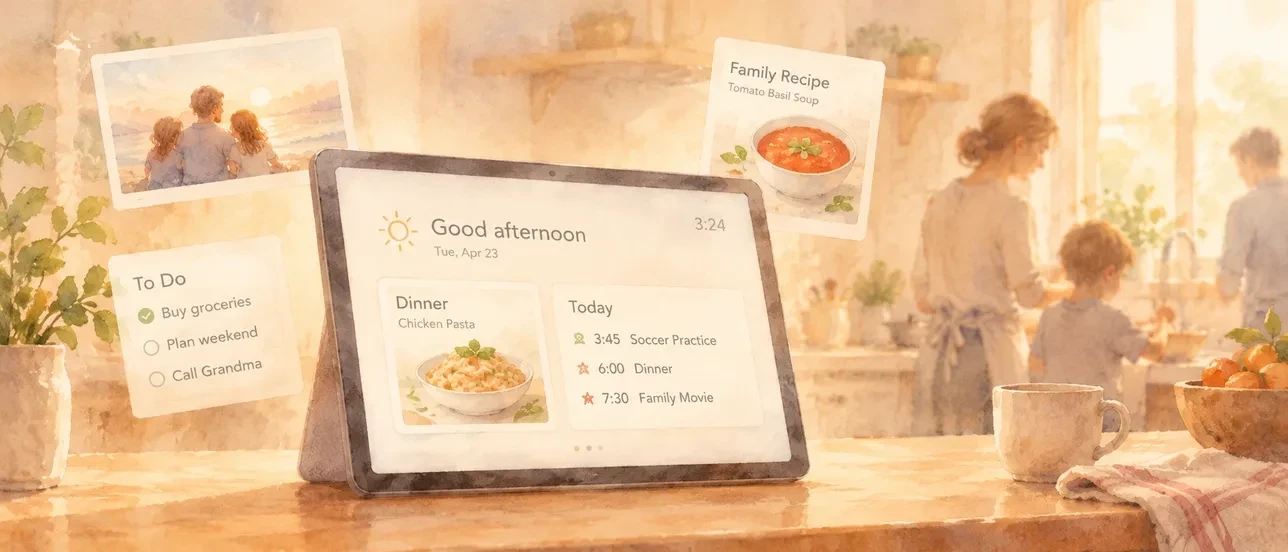
For a long time, I liked the idea of having a central family display in our kitchen more than I liked the reality of actually using one.
The concept made sense. Put a screen somewhere everyone naturally passes through. Show the family schedule. Make it easier to see what is happening without requiring everyone to pull out a phone and open a calendar.
But simply putting a calendar on a screen was not enough.
It took some experimenting, some fiddling, and a better understanding of what we actually wanted that screen to do before it became something our family genuinely valued.
Now it has.
Our kitchen display has become one of those things we could absolutely live without if we had to — but we would not want to.
And one of the strongest opinions I have after living with it for a while is this:
A family hub should be a role a screen performs, not a special piece of hardware you are locked into buying.
The useful part is the shared surface, not the device
There are dedicated family calendar displays on the market, and the basic idea behind them is good. A screen in a central part of the house can make family information dramatically easier to notice.
What I never liked was the idea that the experience had to be tied to one specific screen.
If you already have an iPad, use it.
If you have an older laptop that still runs a modern web browser, use that.
If you want a large touchscreen in the kitchen connected to a small computer, that should work too.
A tablet, desktop, mini PC, touchscreen monitor, or other browser-capable device can all serve the same basic purpose.
There should be no app-store requirement and no need to buy proprietary hardware just to participate in the experience.
That matters for cost, but it also matters for something simpler: ownership.
If you eventually decide ComingUp Today is not for you, the screen is still yours. It still works. You can use it for something else. There is no feeling that the hardware you bought only has value as long as you keep paying for the software attached to it.
The value should be in the service, not in trapping that service inside a particular device.
A calendar on the wall was not quite enough
I originally wanted a central display because our family schedule is busy enough that having it visible in the kitchen sounded useful.
And it was useful.
But a static calendar view still had a limitation: most of the time, nobody was actively using the display.
It was sitting there showing information, but it still felt like a computer displaying a calendar.
That distinction matters more than I expected.
A permanent screen in a common room has to earn the space it occupies. If it constantly looks like a control panel or something demanding attention, it can quickly become visual clutter. If it only shows one static view, people also become surprisingly good at no longer noticing it.
The breakthrough for us was turning the display into something more ambient.
Ambient mode is what made the display come alive
ComingUp Today now has an ambient rotating display that behaves a little like a useful screensaver for the household.
Instead of leaving one calendar page on the screen all day, it rotates through the kinds of things we actually care about:
- family photos
- what is happening today
- what is coming up this week
- useful lists
- notes
- recipes
- other upcoming household information
Then it keeps moving.
That changed the display completely.
The screen stopped feeling like a calendar that happened to be mounted in the kitchen and started feeling like part of the room.
The family photos are a surprisingly important part of that.
A screen showing nothing but appointments, lists, and household logistics can feel utilitarian. Useful, certainly, but still like infrastructure.
Mix those same things between photos of your family and the display takes on a different character. You look at it because there is something pleasant to see, and while you are looking you also notice that someone has an appointment this afternoon, that the week is busier than you remembered, or that a list has changed.
The information becomes visible without constantly demanding interaction.
The kitchen turned out to be the right place for us
Our display lives in the kitchen, and I think that location is a large part of why it works.
The kitchen is one of the few places everyone repeatedly passes through during the day. Breakfast, coffee, lunch, dinner, snacks, getting ready to leave, coming home — there are constant natural opportunities to glance at the screen without deliberately deciding to check anything.
That is very different from having the same information available on a phone.
A phone can contain everything and still require someone to remember to look.
A central display lets information become part of the environment.
That idea connects directly to something I have written about before: shared calendars can be technically shared while still failing to create shared awareness. Access matters, but visibility matters too.
The kitchen display closes some of that gap for us simply by being there.
It is useful even when nobody is actively using it
This is the part I underestimated when we started.
Most technology is useful when you interact with it. You open an app, search for something, change something, or ask it a question.
A good household display can provide value while nobody is touching it.
You walk past and notice what is happening later.
One of the kids sees a family photo.
Someone notices an event that is getting closer.
A list appears and reminds you of something you meant to handle.
The week view comes around and quietly gives everyone a better sense of what the next few days look like.
None of this requires an alert, a notification, or somebody announcing the schedule again.
It is simply visible.
That kind of passive awareness is exactly what I wanted ComingUp Today to provide from the beginning. The goal was never to create another app that everyone in the family needed to spend more time inside. The goal was to make useful household information easier to see when it matters.
When something changes, the display changes too
A central display becomes much less trustworthy if someone has to remember to refresh it.
Family schedules do not sit still. Times change. Events move. Lists get updated. Things are added and removed throughout the day.
When that happens in ComingUp Today, the display can update without somebody standing in the kitchen refreshing the page.
That sounds like a small detail, but it changes whether the screen feels like a live household surface or a digital poster.
If something changes, we want the thing on the wall to reflect the change.
This does not mean throwing notifications at everyone or constantly trying to capture attention. The display can remain quiet while still staying current.
That is also why I care so much about real-time visibility in family coordination. The useful version of real time is often not an alarm. It is simply knowing that the information you are looking at reflects what is actually true now.
Recipes made the hardware itself more useful
The display is also not limited to passive information.
When we are cooking, we can open one of our recipes and use the larger kitchen screen instead of balancing a phone on the counter, repeatedly unlocking it, or trying to read instructions from a small display with messy hands.
That is one of those features that sounds minor until you use it regularly.
The same screen that spends most of the day rotating quietly through photos and household information becomes an active tool when we need it. When we are done, it can return to ambient mode.
That combination is what finally made the display feel worthwhile.
It is not a dedicated calendar screen. It is not a digital photo frame. It is not a recipe terminal.
It can be all of those things at different moments because the device itself is not the product.
If you want to see more about how we think about recipes as part of shared family context, I wrote about why I built recipes into ComingUp Today.
The best household technology gets out of the way
After living with a central display for a while, I do not think the goal should be to make people stare at it more.
The opposite is probably true.
It should be useful when you deliberately need it and quietly informative when you do not.
It should not need constant maintenance. It should not demand that everyone install another app. It should not require the family to adapt their lives around a particular piece of hardware.
It should just be there, showing the things your household needs to know and becoming interactive when someone actually needs to use it.
That is what finally made our kitchen display click for us.
At first, it was an experiment.
Then it was something we had to remember to use.
Now it is simply part of the kitchen.
We look at it throughout the day. We cook from it. We notice schedule changes on it. We see what is coming up. We see our family photos. And even when nobody is actively touching it, it is doing a small amount of useful work in the background by keeping the household aware of what matters.
We could take it down tomorrow and go back to checking everything from our phones.
We would be fine.
But we would miss it.
That is probably the best measure I have found for whether a piece of household technology is actually useful.
If you are interested in building the same kind of shared awareness in your home, see how ComingUp Today works. You do not need a special family-calendar device to start. You need a screen with a modern web browser and a place where your family will naturally see it.